

By Jason Upton – Staff Reporter
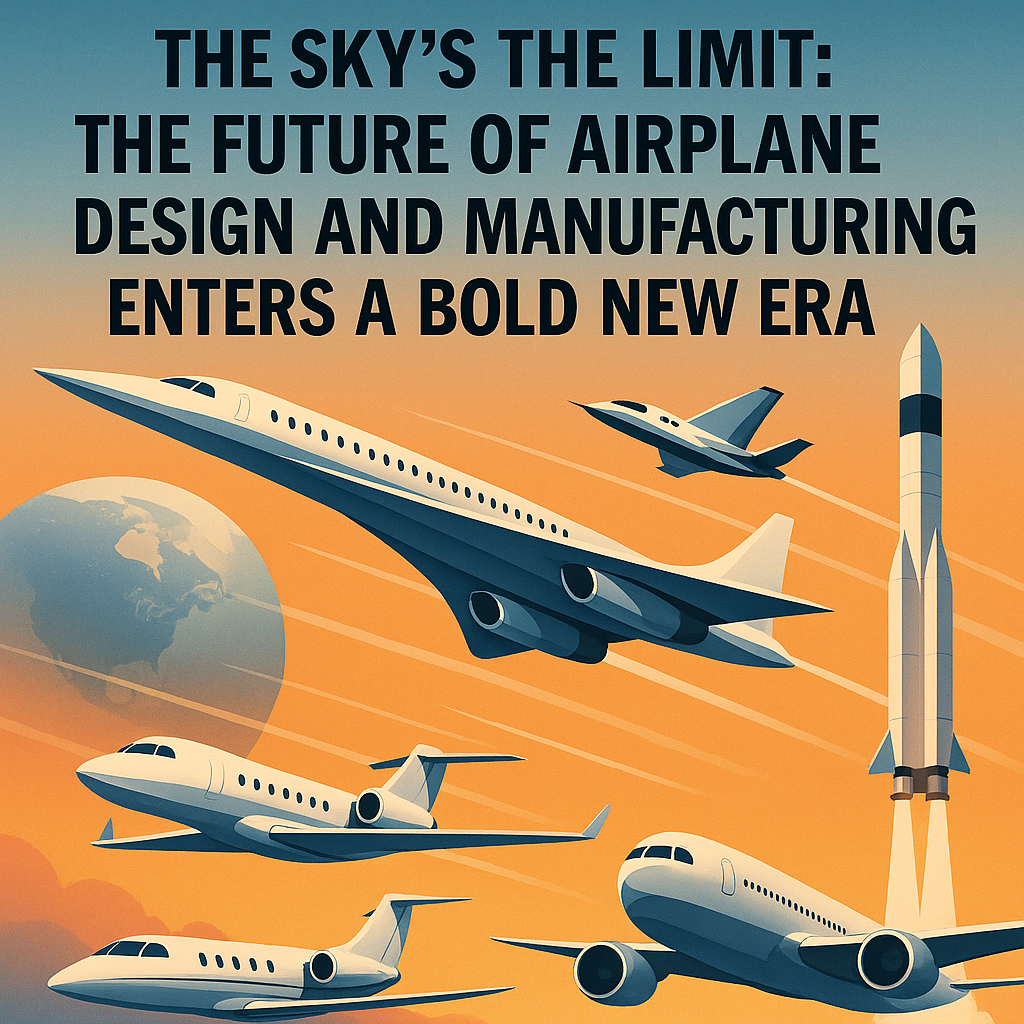
In a quiet hangar outside Denver, engineers huddle around sleek composite airframes that resemble something out of science fiction. A few hundred miles away, a startup in Mojave, California, is testing rocket-powered vehicles that promise to take travelers halfway around the globe in under two hours. Meanwhile, private jets are becoming more affordable, more sustainable, and more technologically advanced than ever before.
Airplane design and manufacturing are entering a period of transformation not seen since the dawn of the jet age. Driven by a combination of environmental pressure, market demand, advances in materials and propulsion, and the growing appetite for spaceflight, the aerospace sector is poised to redefine what it means to fly — and who gets to do it.
Supersonic Flight Returns — Quieter, Cleaner, Smarter
The dream of supersonic flight never truly died with the retirement of the Concorde in 2003. It was simply waiting for the right conditions to take off again.
“We’ve reached a technological tipping point,” says Jennifer Kwan, an aerospace engineer at Boom Supersonic, a Colorado-based company developing a new supersonic passenger aircraft called Overture. “Lighter materials, quieter engines, and better aerodynamics are making supersonic travel commercially viable and environmentally responsible.”
Overture, expected to fly in the latter half of this decade, promises to carry 64–80 passengers at Mach 1.7 — twice the speed of today’s commercial jets. The aircraft will run entirely on sustainable aviation fuel (SAF), aiming to mitigate its environmental impact, a stark contrast to the Concorde’s notoriously high emissions.
Other players like NASA and Lockheed Martin are also investing in quiet supersonic technologies. NASA’s X-59 QueSST aims to reduce the sonic boom to a distant “thump,” potentially lifting the long-standing ban on supersonic flights over land.
If successful, supersonic travel could slash transoceanic flight times: New York to London in 3.5 hours, Los Angeles to Tokyo in under seven. But challenges remain, particularly around regulatory approvals, infrastructure upgrades, and the price of SAF.
“Economics will be key,” says aviation analyst Mark Ferrell. “Unless ticket prices are accessible, supersonic jets may remain a niche product for business elites or special-purpose routes.”
Private Aviation Goes Green — and Digital
While commercial aviation struggles with labor shortages and post-pandemic turbulence, private aviation is soaring.
A decade ago, private jets were synonymous with extravagance. Now, thanks to fractional ownership programs, jet cards, and digital charter platforms, private flying is becoming more accessible — and more sustainable.
Companies like Textron Aviation, HondaJet, and Cirrus are producing lighter, more fuel-efficient aircraft. Meanwhile, electric and hybrid propulsion startups such as Ampaire, Bye Aerospace, and Eviation are developing emission-free alternatives for short-haul and regional flights.
Eviation’s Alice, an all-electric nine-seater, completed successful test flights in 2023 and aims to enter service by 2027. “This isn’t a science experiment anymore,” says CEO Gregory Davis. “We’re building the next generation of clean, quiet, and cost-effective aircraft.”
Digitalization is also transforming private aviation. AI-driven booking platforms like XO, Jet It, and Wheels Up are removing friction from the flying experience, allowing travelers to reserve seats, customize routes, and even share flights for lower costs.
“Technology is democratizing private flight,” says aviation consultant Tara Evans. “It’s not just about luxury anymore — it’s about efficiency, flexibility, and personalization.”
However, experts warn that private aviation still faces scrutiny for its environmental footprint. Despite advances in green propulsion, most jets today still burn fossil fuels. Industry coalitions like Business Aviation Coalition for Sustainable Aviation Fuel (SAF Coalition) are working to increase SAF adoption, but supply remains limited.
Spaceflight: The Final Frontier Gets Closer
The line between air travel and space travel is beginning to blur. What once required national budgets and launchpads now rests in the hands of private visionaries and investors.
Space tourism, a science-fiction dream until recently, became reality with companies like Blue Origin, Virgin Galactic, and SpaceX sending civilians past the Kármán line — the edge of space.
“Spaceflight is the next logical step in human mobility,” says Dr. Lucia Reyes, a senior researcher at MIT’s Space Propulsion Lab. “It’s not just for astronauts anymore. It’s becoming a platform for high-speed point-to-point travel on Earth.”
SpaceX’s Starship, designed for Mars missions, has been floated as a vehicle for suborbital Earth flights, capable of connecting major global cities in under 90 minutes. Virgin Galactic and Blue Origin are focusing on short-duration experiences for wealthy thrill-seekers — but prices are expected to drop as reusability and scale improve.
The technological overlap with aviation is substantial. Heat-resistant alloys, autonomous flight control systems, and vertical takeoff/landing (VTOL) capabilities developed for space are influencing airplane design and vice versa.
“There’s real synergy here,” says aerospace executive Miles Carroll. “As spaceflight matures, it will feed innovations back into commercial aviation — from materials to telemetry.”
Manufacturing: Smarter, Leaner, Faster
Modern aircraft are increasingly assembled, not built, using advanced supply chains, robotics, and additive manufacturing (3D printing).
“We’re seeing a complete reimagining of how aircraft are made,” says Annika Jørgensen, CTO at an aerospace tooling firm in Seattle. “Automation, digital twins, and generative design are reducing development cycles and improving precision.”
Boeing and Airbus are using virtual simulations to test aerodynamics and structural tolerances before cutting a single piece of metal. In parallel, manufacturers are embracing composite materials like carbon fiber, which are lighter and stronger than traditional aluminum, leading to better fuel economy.
Additive manufacturing is enabling custom parts to be printed on demand, reducing inventory and waste. GE’s LEAP jet engine, for example, contains dozens of 3D-printed parts, contributing to its superior thrust-to-weight ratio and lower emissions.
Supply chain decentralization — accelerated by the COVID-19 pandemic and geopolitical tensions — is also leading to more regionalized production. Aerospace firms are building modular components in multiple countries, reducing risk and increasing resilience.
What’s Next: The Hybrid Sky
The future of flight likely won’t belong to a single technology or sector — but to a hybridized ecosystem of air mobility.
Urban air taxis, such as Joby Aviation’s eVTOL aircraft, are being positioned for short intra-city hops. Supersonic jets will serve transoceanic business travelers. Electric planes will link regional destinations. And spaceplanes may one day connect continents in under two hours.
Behind all of this is a growing societal emphasis on sustainability and access. As governments push for net-zero emissions targets by 2050, aviation will be under increasing pressure to decarbonize — and fast.
Startups, legacy manufacturers, regulators, and even passengers will need to collaborate on new standards, certifications, and infrastructure. That includes SAF refueling stations, electric charging ports at airports, air traffic control systems adapted for higher-altitude and autonomous flights, and equitable policies to ensure these innovations don’t widen social divides.
Despite these challenges, the optimism is palpable.
“Flying has always symbolized progress,” says Dr. Reyes. “Now we have the tools to make it not only faster and farther — but also cleaner, smarter, and fairer.”
Whether that future arrives in five years or fifty, one thing is clear: the next generation of flight won’t look like the last. And for the first time in decades, the sky truly feels limitless again.